
“I experienced ‘spiritual heartburn’ for Jesus Christ from the pages of Ruth. Loved it!”
“Makes me want to study the Old Testament even more.”
“I didn’t know there was that much depth in the little book of Ruth.”
– Misc Responses from early readers
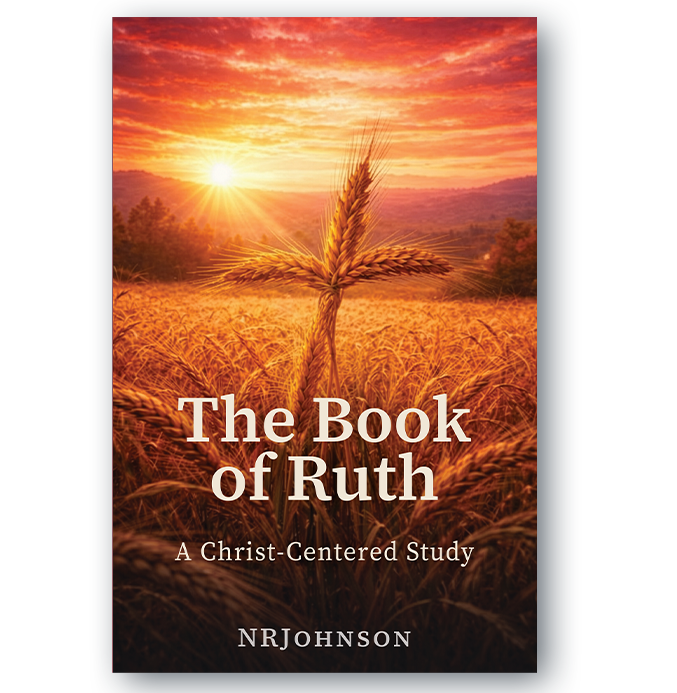
See the Majesty of Jesus in the Old Testament book of Ruth
At first glance, Ruth appears small and unassuming, tucked quietly between seasons of rebellion and kingship. But within its brief narrative unfolds a rich portrait of God’s lovingkindness and redemption. Far from being merely a human romance or moral tale, the story of Ruth ultimately points beyond itself to Jesus Christ, our majestic and unmatched Kinsman-Redeemer.
The Book of Ruth is an approachable yet in-depth, Christ-centered study of redemption and mercy. Through careful exposition and worshipful reflection, this study invites readers to look beyond the familiar story and behold how God brings fullness out of emptiness, hope out of despair, and redemption where it seems least likely. Ruth’s story is not only a testimony of God’s faithfulness back then—it is a living declaration of His redeeming work today.
Published: 2026
Pages: 168
Print ISBN: 978-1-953549-10-5
eBook ISBN: 978-1-953549-11-2
Chapter 3
Beauty Amidst Bitterness and Blight
(Ruth 1:3–22)
To recap, the Book of Ruth starts with a famine in the Promised Land severe enough to force Elimelech and his family to leave Bethlehem (the house of bread) in search of bread elsewhere. They travel to Moab (enemy territory) to seek refuge and rations. In their attempt to preserve life, they only find death and greater distress.
And everything turns on its head. What we presume are the main characters of the story are all gone by verse five—only Naomi and her daughters-in-law remain.
Then Elimelech, Naomi’s husband, died; and she was left with her two sons. They took for themselves Moabite women as wives; the name of the one was Orpah and the name of the other Ruth. And they lived there about ten years. Then both Mahlon and Chilion also died, and the woman was left without her two children and her husband (Ruth 1:3–5).
The World of Patriarchs
The loss of a husband and two sons would be devastating, but in the culture Naomi finds herself in, it is earth-shattering.
In ancient Israel, a woman’s security and value were largely tied to the men in her family. As a wife, Naomi’s primary responsibility is to produce sons for her husband, and she succeeded. Two sons. Her duty fulfilled. Her future seems secure.
Though it is devastating when Elimelech dies, leaving her a refugee widow in Moab, at least she still has her two sons. They will care for her. They will carry on the family line; double insurance for her future.
When her sons marry Moabite women, there is even greater hope—grandchildren to carry on the family’s line and legacy. Yet, ten years pass without a pregnancy. Think about what that means. With a woman’s normal monthly cycle, Naomi likely endures with Ruth and Orpah as many as 240 agonizing disappointments. Month after month. Year after year. Hope, then heartbreak. Hope, then even greater heartbreak. *1
And then her sons die.
This isn’t just personal loss—this is the complete destruction of her life’s work. In the patriarchal culture of her day, when they buried Mahlon and Chilion, they essentially buried Naomi too. She has no husband. No sons. No grandchildren. No future. No security. No value in her culture’s eyes.
Naomi is alive, but in every way that matters to her world, she is finished. Only barrenness, bitterness, and blight remain.
Genesis 16:1–3 tells us Abraham and Sarah also faced a decade of barrenness, to which they took matters into their own hands and used the servant Hagar to attempt to bring about God’s promised child. Yet Ishmael was rejected (see Genesis 17:18–21). Twenty-five years pass between the promise of a son and the birth of Isaac. That’s a long time to wait and hope.
But for Naomi, no hope is in sight. She lacks the provision and protection that Elimelech provided. As an older woman, whose parents have likely died, there is no possibility of returning to her father’s house. Though she could remarry, she is beyond childbearing age and thus undesirable in that culture. And though a widow in our day might support herself with some sort of craft or trade, most women in antiquity did not have that option. *2
In short, her hope is gone, and culturally, by losing her husband and sons, she also loses her entire identity. I mentioned this in chapter two, but names are significant in Scripture—it is someone’s autobiography, identity, character, and reputation in one word. And there is a heartbreaking picture of this in Ruth 1:5, “Then both Mahlon and Chilion also died, and the woman was left without her two children and her husband.” Naomi is nameless. The event’s intensity underscores Naomi’s despair and emptiness by removing her name and referring to her as “woman.”
Naomi is in absolute peril. No provision, protection, or direction. She lost everything. Several scholars point out that Naomi is a female version of the tragic (and yet triumphant) story of Job. *3
Think about the parallels. Job loses his livestock, servants, children, and health—everything is stripped away in rapid succession. Naomi endures famine, refugee life, and the deaths of her husband and both sons. Both experience total devastation. Both Job and Naomi are met by friends who barely recognize them because of their grief (see Job 2:12; Ruth 1:19).
The big difference between the two sufferers is that Job can start over, but Naomi can’t. As an older widow, past the years of childbearing, she’s finished, with no possibility of starting over. No second act. No rebuilding. What she lost appears to be gone forever.
Notice what both sufferers do: they turn their attention away from secondary causes and cry out to God. Job questions God’s justice: “Why have you set me as Your target?” (Job 7:20). Naomi doubts God’s love: “The Almighty has dealt very bitterly with me” (Ruth 1:20). Job asks if God is fair. Naomi asks if God is good.
So Naomi’s question lies at the heart of the story—is Yawheh truly the God of “hesed” (lovingkindness, mercy, faithfulness)? It’s the driving force of everything that follows (note: we will dive deeper into the concept of hesed in the next chapter).
And here’s what’s remarkable: for both Job and Naomi, God does not explain the reasons behind their losses. God doesn’t give Naomi a theological treatise on suffering. He gives her something better—He gives her redemption. He shows her His hesed (covenant love and mercy) in the actions of Ruth and Boaz.
Ponder this: sometimes God’s answer to our “Why?” is not an explanation but rather a demonstration of His life, love, and character.
Go Back to Your Family and Gods
With nothing to keep her in Moab, and hearing food has returned to the “house of bread” (Bethlehem), Naomi decides to return home to see what hope she might find there.
Then she arose with her daughters-in-law and returned from the fields of Moab, for she had heard in the fields of Moab that Yahweh had visited His people to give them food. So she went forth from the place where she was, and her two daughters-in-law with her; and they went on the way to return to the land of Judah. And Naomi said to her two daughters-in-law, “Go, return each of you to her mother’s house. May Yahweh show lovingkindness [hesed] with you as you have shown with the dead and with me. May Yahweh grant that you may find rest, each in the house of her husband.” Then she kissed them, and they lifted up their voices and wept. And they said to her, “No, but we will return with you to your people.” But Naomi said, “Return, my daughters. Why should you go with me? Have I yet sons in my womb, that they may be your husbands? Return, my daughters! Go, for I am too old to have a husband. If I said I have hope, if I should even have a husband tonight and also bear sons, would you therefore wait until they were grown? Would you therefore refrain from marrying? No, my daughters; for it is more bitter for me than for you, for the hand of Yahweh has gone forth against me.” And they lifted up their voices and wept again; and Orpah kissed her mother-in-law, but Ruth clung to her. Then she said, “Behold, your sister-in-law has returned to her people and her gods; return after your sister-in-law” (Ruth 1:6–15).
Before she leaves, Naomi attempts to send her two daughters-in-law away. While it may appear harsh from a modern perspective, it is an act of mercy and kindness. Naomi realizes she has nothing to offer them in Bethlehem—no guarantees of survival, no hope for marriage, and bringing two Moabite women into Israel could risk great harm to their lives, since they are a part of all four major demographics that define the vulnerable in the Bible: the widow, the orphan, the poor, and the foreigner. *4
In short, Naomi tells them, “There is no hope for me, and if you go with me, there will be no hope for you … God is against me (1:13), and if you go with me, He’ll be against you too.”
So Orpah departs from Naomi and returns to her family and her Moabite gods (1:15), but Ruth refuses to do so. *5
The Character of Ruth
Ruth’s response is profound. In Ruth 1:14, it says Ruth clings to Naomi. The Hebrew word means to cling, stick, cleave, hold, to hold firmly or tenaciously to, hang on, keep close, adhere, to be glued. The concept is “to stick like glue.” The word is used to describe a tongue clinging to the roof of the mouth (see Job 29:10; Ezekiel 3:26), a hand clinging to a sword (see 2 Samuel 23:10), and to express loyalty and affection either in marriage, to a king, or to God (see Genesis 2:24; Deuteronomy 10:20; 11:22; 30:20; Joshua 22:5; 2 Samuel 20:2; 2 Kings 18:6).
This word appears in various places in the Old Testament, most notably in Genesis 2:24: “Therefore a man shall leave his father and his mother, and cleave to his wife; and they shall become one flesh.”
One scholar defines the term, saying it “implies firm loyalty and deep affection. … It requires leaving membership in one group to join another. Thus, Ruth’s gesture signals her commitment to ‘abandon’ her Moabite roots to remain with Naomi permanently.” *6
Ruth further refuses to leave Naomi by her seven-fold commitment:
But Ruth said, “Do not press me to forsake you in turning back from following you;
1) for where you go, I will go,
2) and where you lodge, I will lodge.
3) Your people shall be my people,
4) and your God, my God.
5) Where you die, I will die,
6) and there I will be buried.
7) Thus may Yahweh do to me, and more, if anything but death separates you and me.”
So she saw that she was determined to go with her, and she said no more to her (Ruth 1:16–18).
This, too, becomes a chiasm (see chapter one), in which the center (and emphasis) of Ruth’s declaration is: “Your people shall be my people, and your God, my God.”
This isn’t a half-hearted decision for Ruth; she is all-in with no backup options (no Plan B). Ruth’s decision is lifelong: she commits to remain in Israel and be buried alongside Naomi. *7 Returning to Moab will not be an option. Not only will the land of Israel be her new home, but Yahweh will be her God. She is forsaking all others, her past family, heritage, and culture, to be fully devoted to Naomi and her God. The seriousness of her decision is confirmed with her oath: “Thus may Yahweh do to me, and more, if anything but death separates you and me” (1:17).
Ruth’s “conversion” to Naomi’s God and life is a beautiful fulfillment of God’s promise to Abraham in Genesis 12:1–3. In another, seven-fold declaration (emphasized by the English word “and”), “Yahweh said to Abram, ‘Go forth from your land, and from your kin and from your father’s house, to the land which I will show you; and I will make you a great nation, and I will bless you, and make your name great; and so you shall be a blessing; and I will bless those who bless you, and the one who curses you I will curse. And in you all the families of the earth will be blessed.’” God told Abraham he would be blessed, and when the onlooking world saw all that God would do in the life and legacy of Abraham, they, too, would want Yahweh as their God. We find glimpses of this covenant promise not only in Ruth but also in Rahab, the Jericho prostitute, who declared, “… for Yahweh your God, He is God in heaven above and on earth beneath. So now, please swear to me by Yahweh, since I have shown lovingkindness to you, that you also will show lovingkindness to my father’s household and give me a pledge of truth, and preserve my father and my mother and my brothers and my sisters alive, with all who belong to them, and deliver our lives from death” (Joshua 2:11–13).
Ruth, like Rahab, beholds the beauty, faithfulness, and blessing of Yahweh, and desires to be adopted into the people of God.
Oh, that our lives would do the same with the onlooking world! The promise given to Abraham in Genesis 12 is fulfilled in Jesus Christ—the One in whom all the peoples of the earth are blessed. Now we, as believers, have the privilege and commission to declare to the world, with our lives and lips, that Jesus is the Living God and that in Him is life, forgiveness, and hope. When the world watches us, may they ultimately see “Christ in us, the hope of glory” (Colossians 1:27) and desire to be rescued “from the authority of darkness, and transferred … to the kingdom of the Son of His love” (Colossians 1:13). What an incredible privilege we have as Christians to showcase the life and love of our precious Savior to the world!
Return to Bethlehem
When Naomi and Ruth arrive in Bethlehem, “all the city was stirred because of them” (Ruth 1:19). In short, the whole city is “buzzing like bees” (stirred up, noisy, in commotion). *8
In the midst of such commotion, “the women said, ‘Is this Naomi?’ She said to them, ‘Do not call me Naomi; call me Mara, for the Almighty has dealt very bitterly with me. I went out full, but Yahweh has caused me to return empty. Why do you call me Naomi? Yahweh has answered against me, and the Almighty has brought calamity against me’” (Ruth 1:19b–21).
Twice, Naomi uses the name of God Shaddai (Almighty). The name denotes God as all-powerful and in control of all things. According to Naomi, God Almighty, the one who controls all things, dealt with her harshly and left her empty-handed (a deeply sad conclusion, given that Ruth is standing beside her). Naomi is convinced God brought calamity against her and is the cause of all her trials, bitterness, and distress. *9
This climaxes in a delightful play on words—Naomi declares she should not be called Naomi (sweet, pleasant) but rather Mara (bitter). Yet, despite her bitterness, there is a hint that by the end of the story, sweetness will return: “So Naomi returned, and with her Ruth the Moabitess, her daughter-in-law, who returned from the fields of Moab. Now they came to Bethlehem at the beginning of barley harvest” (Ruth 1:22).
What About Us?
So, how can we apply all this to our lives? Two ideas:
1. Total Commitment to God
In the story, Ruth is willing to leave her former life and forsake it to embrace the one true God.
… but Ruth clung to her … [and] said, “Do not press me to forsake you in turning back from following you; for where you go, I will go, and where you lodge, I will lodge. Your people shall be my people, and your God, my God. Where you die, I will die, and there I will be buried. Thus may Yahweh do to me, and more, if anything but death separates you and me” (Ruth 1:14, 16–17).
Though it’s a bit long, this quote by Peter Lau helps us understand the gravity of Ruth’s decision:
We must not underplay the significance of Ruth’s decision to return with Naomi. Returning with Naomi meant permanently turning her back on her family, her people, her land, and her gods—in life and death. In group-oriented cultures, loyalty is highly prized, while disloyalty is frowned upon. … in contrast to Orpah, Ruth’s decision would be permanent. She was willing to be disloyal to her people to remain loyal to Naomi. In turning her back on her relationships in Moab, Ruth forfeits any hope of future benefit from her former society. And since loyalty is closely linked with honor, breaking from one’s people and traditions is often considered shameless. Moreover, she was willing to live with the shame of perpetual widowhood. Naomi made it clear that security and rest for her widowed daughters-in-law were to be found in a new husband and family—back in Moab. She could not produce any more sons for them, and the implication was that they would not be able to find husbands in Israel. Yet Ruth was willing to forgo personal security and restored social status for the sake of her mother-in-law. Ruth’s is an all-in loyalty and commitment to Naomi at an exceptional personal cost. *10
The question before us is the same for Ruth: Am I willing to leave and forsake my “old life” to embrace the Living God?
Paul tells us that “if anyone is in Christ, he is a new creation; the old things passed away; behold, new things have come” (2 Corinthians 5:17). In Jesus, our identity changes. But if we are going to give up our old lives to embrace the new one, we must be willing to throw off everything that used to define us in order to live in light of our new identity in Christ Jesus.
For example, to use Paul’s contrast between the fruit (deeds) of the flesh and the fruit of the Spirit, we must be willing to forsake and, with God’s enabling grace and power, turn away from all “sexual immorality, impurity, sensuality, idolatry, sorcery, enmities, strife, jealousy, outbursts of anger, selfish ambition, dissensions, factions, envying, drunkenness, carousing, and things like these” (Galatians 5:19–21, also see 2 Timothy 3:2–5). Though we may have grown up with these behaviors as “normal” in our lives, excusing them as personality, identity, or the like, when we turn to Jesus, we must forsake and abandon our old life, gods, and identity for our new life in Christ Jesus (i.e., marked by and showcasing His life and character: love, joy, peace, patience, kindness, goodness, faithfulness, gentleness, and self-control; see Galatians 5:22–23).
This is certainly true for Ruth, who gives up her culture, pagan gods, comforts, and even her family to follow Naomi and become integrated into the people of Israel. She forsakes her past and present lifestyle to embrace Yahweh God as her future.
As J. Vernon McGee wrote, “Ruth makes a real decision for God. She says, ‘I accept the poverty. I accept being an outcast. I also accept the fact that I will remain a widow the rest of my life.’ She was willing to accept all of that in order to take a stand for God. She makes her decision to go back to Bethlehem with Naomi.” *11
Like Ruth, are you willing to leave and forsake your “old life”—your identity, your “gods,” your status, your everything—to embrace the Living God?
Jesus says in Matthew 16:24, “If anyone wishes to come after Me, let him deny himself, and take up his cross and follow Me.” He also says, “… any one of you who does not renounce all that he has cannot be My disciple” (Luke 14:33, ESV). *12
In the Shema (the most popular passage of the Old Testament), it says, “Yahweh is our God, Yahweh [alone]! You shall love Yahweh your God with all your heart and with all your soul and with all your might” (Deuteronomy 6:4–5). Is it true in your life that you love God with all you are and all you have? For it is God alone who is worthy of our affection, worship, and lives.
2. See the end of the story
Naomi’s life, like Job and several Psalms, transitions from lament to praise. There is a place for lament in the Christian life, but we also need to remember God is at work and has an end to the story—even in the midst of our season of lament.
Rather than allow our personal pain and distress to blind us to God’s providential care in our lives, we need, as Charles Spurgeon said, to “learn to kiss the waves that throw me up against the Rock of Ages.” *13
Lament, pain, distress, difficulty, tribulation, and trials can all be used by God in our lives to bring about His purpose and plan. As David Platt observed, “God loves to take sorrowful tragedy and turn it into surprising triumph.” *14
Though Naomi is blinded by her bitterness and blight and can’t yet behold the beauty of what God is doing, her life is a reminder that we, too, need to trust God for the end of the story.
Pastor and scholar Randall D. Smith once said, “You are studying the Scriptures so you can know the character of God. So that when His acts make no sense, His character is what you trust. Don’t trust the circumstances, trust the character of God.” *15
If we are to triumph amidst our tragedies, we must know God’s character. We must remember that, “He Himself has said, ‘I will never desert you, nor will I ever forsake you,’ so that we confidently say, ‘The Lord is my helper, I will not be afraid. What will man do to me?’” (Hebrews 13:5–6).
If we know God wants to use our trials and difficulties (for our good and His glory, see Romans 8:28; 1 Peter 1:6–7), we would stand in confidence and hope (in Him) amidst any storm. James writes, “Consider it all joy, my brothers, when you encounter various trials, knowing that the testing of your faith brings about perseverance. And let perseverance have its perfect work, so that you may be perfect and complete, lacking in nothing” (James 1:2–4).
When Joseph was sold into slavery by his brothers, he could have blamed God. Yet, he trusted God and His character and, in looking back, saw God’s providential care and purpose. He told his brothers after their father died, “As for you, you meant evil against me, but God meant it for good in order to do what has happened on this day, to keep many people alive” (Genesis 50:20).
Paul has a similar outlook on life. He writes, “And we know that for those who love God all things work together for good, for those who are called according to His purpose. Because those whom He foreknew, He also predestined to become conformed to the image of His Son, so that He would be the firstborn among many brothers …” (Romans 8:28–29). Paul says God will use the good, bad, and ugly in our lives so that we might be conformed (shaped, transformed, pressed) to look ever more like Jesus.
Do you have a glimpse of the end of the story? You may not know how your circumstances will end, but you can stand firm knowing the character of Jesus Christ and that He will use all things in your life to bring about His purpose and plan, and to conform you to Himself. As Paul exhorts, “And not only this, but we also boast in our afflictions, knowing that affliction brings about perseverance; and perseverance, proven character; and proven character, hope; and hope does not put to shame, because the love of God has been poured out within our hearts through the Holy Spirit who was given to us” (Romans 5:3–5). Paul says he can boast (brag, celebrate) in his tribulations because He knows what God is doing with them. Do you?
—
While Naomi and Ruth are now in Bethlehem, their plight isn’t over. They desperately need food, protection, and ultimately a redeemer. And it just so happens that Boaz is unknowingly waiting to give them everything they need.




Disclosure of Material Connection: Some of the links in the post above are “affiliate links.” This means if you click on the link and purchase the item, deeperChristian will receive an affiliate commission (with no additional cost to you). It is a great way to support the work and ministry of deeperChristian. Regardless, we only recommend products or services we use personally and believe will add value to our readers. We are disclosing this in accordance with the Federal Trade Commission’s 16 CFR, Part 255: “Guides Concerning the Use of Endorsements and Testimonials in Advertising.”